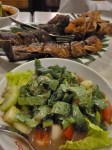
This gallery contains 13 photos.
There was a time I would do my top 10 favorite restaurants of the year. However, I found that most …

09 Wednesday Jan 2013
Posted in Food Glorious Food
This gallery contains 13 photos.
There was a time I would do my top 10 favorite restaurants of the year. However, I found that most …
16 Tuesday Oct 2012
Posted in Come Taste My Philippines
Tags
Doesn’t look like much, does it? It looks just like any ordinary egg. But do not be deceived — the balut is for the consumption and enjoyment only of the gastronomically daring and the adventurous. And if you do dare, I assure you that once you taste it, you’ll be an addict … for life! Like my Singaporean friend Symon Ler.
I remember when I was a child, as dusk settled over the city, the ambulant balut vendor, like clockwork, would walk past our house, shouting in a distinct melodic tone “Balu-u-u-u-t!!!” My Dad loved it and would enjoy one with his daily beer before dinner. The whole ritual of eating it fascinated me. First, he would determine the “butt” side of the egg and crack it gently, enough to peel away a small hole. He would then slurp all the hot ducky broth through that hole — very noisily, if I may add — before peeling away more of the shell to reveal the golden yolk and ducky embryo inside. He would then proceed to eat all that’s inside — except for the toughened albumin, which my dog would happily dispose of. I eventually learned to love balut. And at one point in my college days, it became one of my food obsessions (more about that in another post) that I would skip a class and my professor would find me sitting by one of the campus kiosks, demolishing up to 5 baluts at a time, washed down with Coke!
Way back in 1997, I even “defended” it in a Salon.com column called Mondo Weirdo. Andrew Zimmern, host of Bizarre Foods on the Discovery Travel and Living channel, said in one interview, “I found it actually quite ordinary in the sense that it tasted like a hard-boiled egg with roasted duck inside of it. I really quite enjoyed it. It was surprisingly good in the sense that I was prepared for it to be stranger to my palate than it really was.” Nowadays, balut has become more than just a culinary curiosity. It’s been made “haute-cuisine-ized” into a soufflé, cooked adobo style, or deep-fried (called tokneneng, which is eaten with chili vinegar).
Balut is NOT unique to the Philippines. The idea of eating fertilized duck eggs came from the Chinese who traded with the Philippine islanders a long time ago. It seems most Asian men back then (and maybe until now?) believed that eating balut enhanced their virility! Really? Their virility needs enhancing??? Anyway, I read that the Vietnamese, who also got it from the Chinese, prefer the chick in their balut, which they call hot vit lon, a little older— with feathers and bones already developed!!! Anthony Bourdain tried the Vietnam version and, no, he wasn’t that sold on it. I wouldn’t go for a boiled egg with a half-incubated baby duck inside either. For us Filipinos, the ideal balut should be only about 17 days old. That is what’s called “balut sa puti” (“wrapped in white”) — the white is the albumin, which is the source of protein food for the developing chick embryo. Although pronounced as balút, with accent on the second syllable, the root word balot means “to wrap”. So, the albumin is not too hardened and the chick inside should not be mature enough to show its beak, feathers or claws, and the bones should be undeveloped.
Just goes to show — different yolks for different folks.
13 Thursday Sep 2012
Posted in Flashback, Food & Travel
The “ber” months have arrived. And the slightly cooler temperatures get me dreaming about going over to Hong Kong soon for a food trip.
There is no dining destination in Southeast Asia quite as full-on satisfying and culinarily comprehensive as Hong Kong. Last August (appropriately the month of the Chinese Hungry Ghost festival), my friends and I joined the Pinoy Eats World food tour to eat our way through Hong Kong. Although the Philippines and Singapore are great foodie ports of call, they cannot match the wide-ranging diversity and deliciously extensive range and depth of both Chinese and Western cuisines that Hong Kong serves up. From the dingy dai pai dong stalls in Wanchai and yum cha restaurants in Causeway that serve steaming-hot bowls of hand-pulled noodles swimming in broth made from rich mother soup stock that may have been stewing continuously for years to the excellent seafood palaces near the waterfront and the most exciting and even innovative Western restaurants this side of the world.
The term dim sum literally means “point of the heart” because these tasty nibbles were originally intended to be snacks, not main meals, and thus only meant to “touch the heart”. According to Wikipedia, “the unique culinary art of dim sum originated with the Cantonese in Southern China, who over the centuries transformed yum cha from a relaxing respite to a loud and happy dining experience.” And, indeed, our Pinoy Eats World group definitely enjoyed a loud and happy dining experience throughout the length and breadth of that tummy-and-soul-satisfying morning.
Our first foray into our food trip was at the small hilly streets and back alleys of Central. There, among the noodle and dim sum houses along Stanley and Wellington Streets, we went “dim sum diving” — sampling roast goose here, spicy beef brisket there, some Beijing-style mutton xiao long bao here and other specialities there. Yat Lok, Nam Kee, Wang Fu, and Maks — we visited all 4 restaurants, with a walk or a hike in between each restaurant to keep our appetites sharp and at the ready for the next nosh. And yet, we had barely skimmed the surface of the dim sum treasures that this fine city has to offer. That is why I want to go back. Perhaps the next time, I will dive a lot deeper and spend 2 or 3 days exploring the hidden dim sum gems of Hong Kong.
If you are interested in joining a food tour organized by the Pinoy Eats World group headed by JJ Yulo, just click on the link, which should take you to their Facebook page. Aside from Hong Kong, they also do Pampanga, Bangkok, and Turkey.
11 Tuesday Sep 2012
Posted in Kitchen Essentials
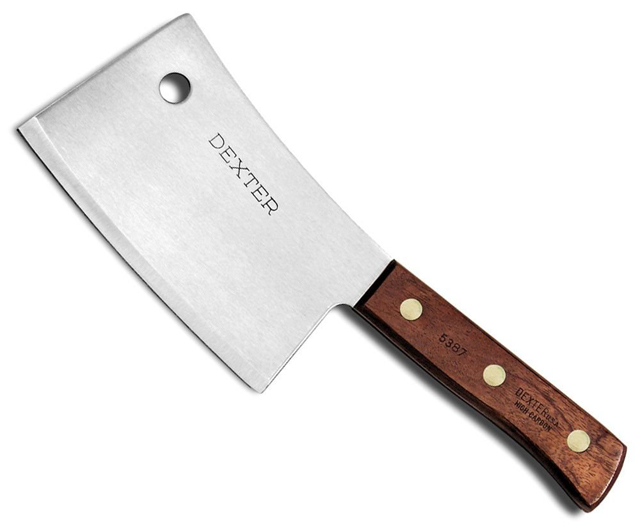
Dexter-Russell 7″ Cleaver
No, I’m not going to Sweeney Todd anybody. It’s just that our old meat cleaver is so old, it bounces when we try to cut through bone! It’s so old, even our cook’s dentures are sharper! But what kind of cleaver to buy? Should I get one with a 6-inch or an 8-inch blade? It’s gotta be bad-ass tough, for sure! With just the right heft and balance for me to be able to cut through bones — to get to them succulent marrows, of course! Or to chop up the Lechon Kawali neatly — and rip through chicken flesh and sinew…
Martin Yan, TV celeb chef, said he created the perfect meat cleaver — not the Chinese cleaver, which is basically a cleaver-shaped chef’s knife that Chinese chefs like to use — but I couldn’t find it on Amazon. So I googled. First I found this review of the best cleavers, tested by Denise Landis, author and NY Times recipe tester in the New York Times website : http://www.nytimes.com/slideshow/2008/01/01/dining/20080102_KITC_SLIDESHOW_index.html
Then I saw this website — http://www.seriouseats.com/2010/08/how-to-choose-buy-care-for-a-meat-cleaver.html
Hmmm…Dexter, huh? My favorite serial killer! Sounds real bad-ass to me. Well okay, technically the brand name is Dexter-Russell, but you get what I mean. 6-inch, 7-inch, or 8-inch…? Hmmm… I think this is the cleaver I want. Now to look for it.
06 Thursday Sep 2012
Posted in Foodie Films
Writing recently about some great chefs I’ve met reminded me of this movie. Who remembers watching this?
Watching Who’s Killing The Great Chefs Of Europe? all over again, since the first time I watched it 3 decades ago, is like rediscovering the unmitigated pleasures of my childhood food favorites. Like “dirty ice cream” (queso flavor) or my lola’s ube halaya cooked over a firewood stove which she stirred and stirred for hours to decadent sticky smoothness. It was such a joy to experience and relish all over again. Yes, even after all this time, even if some language sounds dated and hokey, it is still very much a joy but in a different way, because now I watch it with the eyes and sensibilities of a well-ripened film and food enthusiast.
In a nutshell, the film is a delicious comedy-mystery, spiced with wit and bon mots. George Segal plays the smooth-talking and slightly coarse American fastfood magnate Robby Ross. Jacqueline Bisset is his ex-wife Natasha O’Brien, a renowned and gorgeous patissière “who may become the last course in an enigmatic killer’s lavish platefuls of delicious deaths”. The mammoth (in physical size and thespianic talent) Robert Morley plays the role of Max Vandeveer, “an acerbic gourmet magazine publisher whose cascading series of chins and stomachs bear witness to his love of fine dining”. Unfortunately, all that gourmandizing has taken a toll on his health and his doctor has commanded him to lose 100 pounds by giving up his most favorite dishes in the world — like the Pressed Duck of La Tour d’Argent or Natasha’s supercalorific Bombe Richelieu. Soon, one by one, the great chefs of Europe who created the fantastic dishes Max craves — who, not coincidentally, are all French (at the time, it was the French who ruled the culinary universe) — are murdered in the manner of the their specialities’ preparations. Pressed Duck, hence… you get the picture.
I admit that the years of devouring movies and even of marinating in the critical and cynical world of advertising have jaded my palate just a soupçon. 30-plus years since this movie’s release is a pretty long time, after all, and taste and sensibilities were different then. Movie-goers were perhaps more naive and less demanding than we are today. And watching this film again, it is easier now to cast a jaundiced eye and see through the tricks of misdirection cooked up by director Ted Kotcheff (he also directed Stallone’s “First Blood”). Lovely and elegant Jacqueline Bisset may be, carrying off 70s fashion so stylishly, she was great eye-candy. Sadly, however, she couldn’t act if her life depended on it. I had to suspend my disbelief at several points about her character. For one, it was odd that she was cast as an American chef, what with her obviously very-British accent. What was even odder was her character not knowing what chicory is! But George Segal, oldish (or D.O.M.-ish) as he was even way back then, played the charming, slightly greasy rogue perfectly. He was definitely one funny jamón!
I would love, though, to see a remake of this movie. I can see the trenchant and wittily erudite food critic for Vogue Magazine, Jeffrey Steingarten, playing the role of Max. And the luscious and voluptuous Nigella Lawson would be ideal in the role of the gorgeous patisserie chef Natasha. And there are many among today’s stars who can play the part of the asinine but charming rascal Robby. Robert Downey, Jr. perhaps?
If you are food-and-film lover, as I am, this movie is definitely worth watching. Maybe not among the pantheon of Oscar greats, but consider it a delicious cinematically high-caloric romp.
04 Tuesday Sep 2012
Posted in Food Glorious Food, Hail to the Chef, The Grub Club
When you meet Chef Reynaldo Lim, he comes across as bigger than life. And I’m not talking about physical size, mind you. Although he is rather like a tall and happy Buddha with a bouncing belly to match. But I am actually referring to his large and ebullient personality — he has a childlike charm and infectious vivacity, you just want to hug him. And he is a joy to watch in the kitchen, sometimes serious and stern but most of the time laughing and having the time of his life. His Dom Deluise-ish character and the great fun he derives from cooking is deliciously expressed in the food he serves. Aside from reigning over the kitchen, he also oversees the table decor, choosing the right floral arrangements and decorative touches and even the plateware for the occasion.
The Grub Club had the privilege to have been the beneficiaries of his fabulous food. We could tell how passionate he is about his food because every time a course is served, he would come out of the kitchen and hover over us, checking to see if we were digging in, if we liked the food or not. And if he caught one of us pausing, chatting, and generally not giving due attention to the dish before us, he’d loom over that person and ask “Why aren’t you eating? Don’t you like it?” Which gets that person promptly shoveling the food in his or her mouth and nodding approvingly, mouth too full to speak. If satisfied, Chef Lim would take a generous sip of wine and smile appreciatively. Fortunately, every dish was superb and sumptuous. But the scene sorta reminded me of a Mother Superior standing guard over students during final exams and saying “No talking! Eyes on your own paper!” Hilarious!
Chef Rey’s cuisine has been described as Continental/French with a strong Asian influence. He prefers to describe it as “Western comfort food with Asian overtones”. Just imagine fresh king prawns with aligue (crab fat) and pineapple relish, served atop a hefty serving of Arroz a la Cubana. Or his dessert of Zucchini Cake with Lychee Buttercream icing. He learned his craft at the Culinary Institute of America in New York and apprenticed with David Bouley at his restaurant in Manhattan. From there, Lim was everywhere — on the Today Show, with Lufthansa as its Star Chef, and for more than a decade, in Beijing’s premium dining spot The Courtyard. In 2010, he left the Courtyard and is now part of the team of chefs of Tjioe Catering (pronounced “chew”) with his friends Edwin Tjioe Tan and Chef Jeff “Jaine” Teh. (Find out more about them at their website — http://tjioethecaterer.ph/)
No doubt, Chef Rey Lim amused my bouche no end. Chef Rey Lim reigns supreme!
02 Sunday Sep 2012
Posted in Food Glorious Food, Hail to the Chef, Restaurants
I first met Chef Seiji Kamura way back in 2009 when he had a small and cozy Italian bistro called Don Eduardo’s at the Valuepoint Building in Legaspi Village, together with his partner Ms. Bingbing Santos. The restaurant was named after her father.
Back then, I wrote of Chef Seiji as an uncharacteristically tall and broad-shouldered Japanese who not only looks Pinoy, but even sometimes talks like one. The tanned and soft-spoken Chef Seiji has been working and living in the Philippines for almost 20 years now, starting as the Executive Chef of Tsukiji at the Century Park Hotel in Malate. I first enjoyed his innovative culinary creations when he had his Japanese-fusion restaurant Joan Miró on Pasay Road way back in the early 90s. Aside from his decades of experience in Japanese cuisine, he had also undergone a 2-year stint in France training with the great master himself, Paul Bocuse (one of the proponents of nouvelle cuisine and for whom the international culinary competition, the Bocuse d’Or, is named). I remember teasing Chef Seiji that time: “How international can you get! A Japanese from Yokohama who trained in classical Japanese cuisine AND French nouvelle cuisine cooking Italian in the Philippines!” He was pretty amused himself.
Just this year, Chef Seiji opened his restaurant Seiji along Pasay Road (now called Arnaiz Avenue). He prepares the most masterfully-done traditional Japanese dishes — with ingredients air-flown from Japan such as scallops, sanma (Japanese mackerel pike), wagyu beef — as well as exquisitely inventive and unexpected dishes, our favorite of which was the Foie Gras and Unagi Salad with Aged Balsamic Vinaigrette. Chef Seiji himself will welcome you as you enter and oversees his staff and sous-chefs to make sure everything is just so. In fact, up to now, he wakes up every day in the wee hours of the morning to go to market, usually the Baclaran Seaside Seafood market, to select and buy the freshest ingredients himself, as he has always done since he started working in the Philippines. Although you can order from a selection of premium sakes, he also even makes his own home-brewed sake, flavored with fruits like grapes and pears. And the true professional chef that he is, he holds tasting sessions for his staff so that they can knowledgeably describe to customers what they are like or made of.
For sure, my bouche was more than amused. So much so that Seiji merits a return or two or three…
Seiji Restaurant is located at the ground floor of the Cedar Executive Bldg on 1006 Arnaiz Ave, Makati (across Ayala Center). You may call 478-7550 for reservations.
02 Sunday Sep 2012
Posted in Come Taste My Philippines, Flashback
We came here to Kinabuhayan Café and B&B way back in 2005. Owned by movie production designer and self-taught chef Jay Herrera, it is one of the destinations of the Viaje del Sol art and culture tour of the Southern Tagalog region. It is located in the Herrera family’s ancestral estate and sits at the toe of sacred Mt. Banahaw.
The second photo shows a 3-storey treehouse built on and around a tall and ancient sampaloc (tamarind) tree. It’s so high up, the mountain breezes provide free-flowing natural air-conditioning while you snooze!
You can tell by the offbeat arrangement of artwork and decorative objects that you are in a very creative space. No corner is left unimagined or artistically put together. A broken blue vase half sunk in a duck pond. Mountain breezes play music on the wood and metal chimes which hang from every cabana. Ornately carved wooden chairs and tables usually found indoors are set out in the open.
We stayed in two cabanas — the ground level area has only 3 walls. What should be the 4th wall is left open. A room-sized net provided the buffer from mosquitos while allowing the mountain night air blow cool and fresh. No TV, no phones or cable (I’m not sure if Jay provides wifi now) – just the pets and other creatures and your traveling companions to provide entertainment. Each cabana has its own ensuite toilet and bath, which has no roof. In the morning, the sun shines right through while you take your shower and other ablutions.
If you wish to stay overnight, you can. For FREE! Simply pay for the day’s 3 meals – lunch, dinner and breakfast, which Jay prepares himself. Each meal costs around P500.
The food Jay creates and serves are singular in every way, using locally-grown ingredients. He made us a fantastic dinner with tricolore pastas made up of Penne Arrabiatta (with hot chillis fresh-picked from the Kinabuhayan garden) + Spinach Fettucine with Laing as sauce (Laing is a classic Southern Tagalog dish made of gabi or taro leaves and stalks cooked in fresh gata or coconut cream and chilli) + Fresh Papaya Salad that looks like pasta but is actually made of sweet and semi-ripe (manibalang) papaya fruit, shredded and topped with salsa. He even makes his own desserts like this one that we had: Sweet yam (camote) – baked, caramelized, and diced – topped with fresh coconut cream and chocolate sauce. Accompanied with wafer-thin
crisp camote chips! And the breakfasts are simply hearty and wonderful.
To contact Jay Herrera, you may call or text him at +63916.2215791
29 Wednesday Aug 2012
Posted in Come Taste My Philippines, Flashback
By the end of 2012, the Multiply community site will be closing down. Which means we members will lose all our posts, photos, albums, blogs, etc IF we don’t back them up now. As in now na now na! Since there are precious memories and special experiences chronicled in that site that I simply do not want to lose, I am reposting some of my favorite pieces here, starting with my trip with the family to the town of Dolores in Quezon province one weekend in May of 2005. We stayed at…
Kinabuhay B&B and Cafe, owned by production designer Jay Herrera and his friend Winston Herrera. Here was my original piece about it:
It’s not at all your typical touristic B&B. Of course, each cabana — or kubo, if you will — has its own ensuite toilet & bath and a loft as sleeping quarters, complete with mosquito net. You can even choose to stay in the 2-storey treehouse! But don’t expect the usual “hotel” amenities like air-conditioning, etc. Think RUSTIC, although I did hear that they now have cable TV in each cabana. There was no such thing when we were last there. Kinabuhayan is for people who don’t mind roughing it a little (just a little) and are open to taking in unfilteredly clean and cool mountain air and communing with the great outdoors (and its denizens, too, if you’re “open” enough). It can be as close to nature as you can get, albeit comfortably. If you are open to trying the place, I suggest you bring insect repellent, though, unless you want to be THAT close to nature and have bites to prove it. Don’t worry, there are mosquito nets provided in each kubo, whether you like to sleep up in the loft or downstairs in the veranda/lounge area. And you will sleep. Soundly, deeply. The dark of night is very dark. And you cannot help but be lulled by the slumberous sound of swaying bamboo trees that surround you.
But the “roughing it” is more than compensated by the amazingly delicious gourmet meals that Jay Herrera whips up from his own secret recipes. He describes his dishes as “Pinoy food with a European twist”. This was the first place I had discovered the delicious combination of pasta with classic Laing (fresh taro/camote leaves cooked in spicy, coconut-creamy sauce)! And breakfast? OMG, the breakfasts! Divine!!! So good that even if you’re not a breakfast person, you’ll eat it all up, especially if you intend to go hiking, trekking, exploring, photographing, biking, jogging, etc.
The hostel looks pretty plain and ordinary outside. But inside, it’s like entering another world. Unstudied bohemian. Quaint in an offbeat, very artistic way. Faded photographs of family. Antique chairs and tables and decor. Imaginative and well-selected dinner ware. A broken blue vase lying on the pond. Ducks and dogs strutting aimlessly everywhere. And especially at night, the place feels as mystical and mysterious as the magic mountain of Banahaw that it looks up at. Do not be perturbed if you hear footsteps and laughter in the dark and find no one there. Just say “good evening” to the darkness and go back to sleep.
“You go to bed in one kind of a world and wake up in another quite different, and if this is not enchantment then where is it to be found?”
To this day, Mt. Banahaw is still closed to trekkers and pilgrims. It has been closed and guarded since 2004. To help the mountain cleanse itself and heal from the desecration, destruction, and indignities wrought by negligent, irresponsible, disrespectful, and litterbug visitors. But we did manage to get to the “first level” at the foot of this mystical place, which remains open to the public. It is called Santa Lucia. One just has to climb up and down the 259 steps that have been roughly and unevenly carved onto the mountain to get to the streams. Hell on the thighs and calves, but my mother (who was 78 back then and considered the oldest city-lady to make the arduous trek) managed it, with the help of a swig from water drawn from Santa Lucia’s springs every now and then. The people at the entrance to the mountain applauded my Mom when she finally took her final step onto level ground at her return from Santa Lucia, unscathed and unfatigued.
I did discover, to my dismay though, that my photographs of the various puestos (sacred prayer spots) were all blanked out, except for one. I remember the Banahaw people who watched me take shots had looked at each other knowingly but I just shrugged it off as the indulgent amusement of rural folk. Now I know they knew something I didn’t.
24 Friday Aug 2012
Posted in Come Taste My Philippines
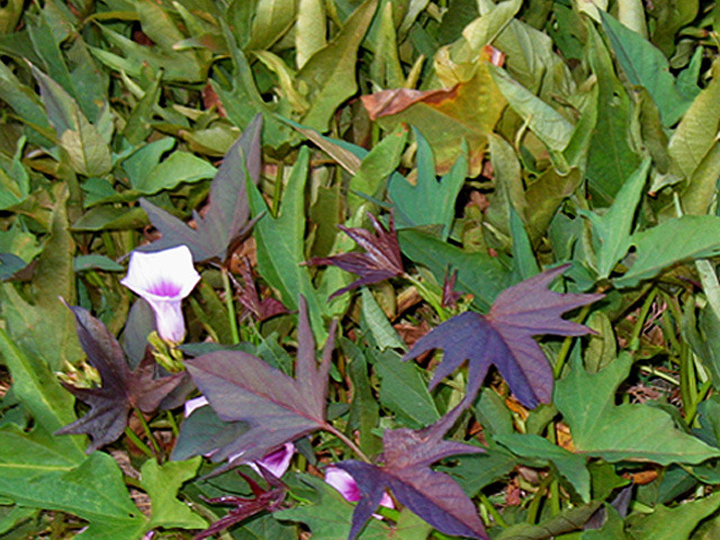
Talbos ng Kamote
The ubiquitous camote plant. Everywhere I walk in our neighborhood, chances are I will always come upon a patch of camote plants, either growing wild in an empty lot or deliberately planted in a home-style garden for that household’s consumption. It’s just like the kangkong — also called swamp cabbage or water spinach — which grows year ’round and grows lush in wet areas like swamps, marshes, and waterways. But with the camote or sweet yam, you can dig up the rootcrop and enjoy it many ways. You can caramelize it for dessert (with a dash of Tanduay Rhum maybe, if you prefer a little kick), boil and dice for halo-halo, fry it as chips, cook and eat it as part of a viand, or even bake bread or a pie with it.
I’ve seen residents and their household helpers walking the streets carrying a bunch home! Many times I myself am tempted pull out and harvest a handful or two of the humble talbos ng kamote (camote tops or the shoots and leaves of the sweet yam) to bring home and have for lunch or dinner as a salad.
To make a simple salad, I steam or poach the talbos for a few minutes. And rinse them immediately in cold water and drain afterwards. Then I mix some diced raw onions and tomatoes. Then for the dressing, just a balanced blend of kalamansi and bagoong na isda (I prefer the ones from Pangasinan, rather than from Balayan). The salad is a perfect partner with crispy danggit maybe or daing na bangus or any fried or grilled seafood.
So down-home simple and easy yet so good!
 A Bouche Amused